Source Flat Indoor Drop Cable for Office, Home, and Data Centers
Compare 30 flat indoor drop cable options featuring G652D and G657 fibers with LSZH or PVC jackets. These single-mode and multicore cables offer tensile strength and lateral pressure resistance for reliable indoor communication installations; compare the available evidence and request quotations based on your requirements.
Key considerations
Products List




Comprehensive Sourcing Guide
Flat Indoor Drop Cable Sourcing Guide
Procuring flat indoor drop cables requires careful attention to the specific physical constraints of the installation environment, particularly where space is limited or aesthetic integration is critical. The observed product data indicates a strong focus on flat wire geometries designed for indoor communication applications, often utilizing tight buffer structures to maintain flexibility while protecting the fiber core. Buyers must verify that the selected cable profile matches the intended routing path, as the flat shape is specifically engineered to minimize profile height in ceiling plenums or under-floor conduits.
The market listings reveal a diverse range of fiber types, including G652D and G657 variants, which dictate the cable's performance in bending scenarios and long-distance transmission. When sourcing, it is essential to confirm that the fiber count aligns with the immediate deployment needs, as observed models range from single-core configurations up to twelve cores. This variation directly impacts the complexity of the termination process and the scalability of the network, requiring buyers to balance current requirements with future expansion potential without over-investing in unused capacity.
Product Scope and Observed Listing Signals
The observed product scope centers on single-mode fiber cables designed for indoor environments, characterized by a flat wire shape and specific jacket materials like LSZH or PVC. These cables are typically constructed with a bow-type tight buffer structure and reinforced with parallel steel or FRP strength members to withstand installation tension. Buyers should note that the listings explicitly mention applications for indoor communication, ensuring the product is suitable for final drop connections rather than long-haul backbone infrastructure.
Listing signals indicate significant variability in core counts and fiber types, ranging from standard G.652D to bend-insensitive G.657A2 fibers. The presence of integrated wiring devices and ODF compatibility in some listings suggests these products are often part of a broader structured cabling ecosystem. Procurement teams must scrutinize the specific model numbers, such as GJXH or GJXFH, to ensure the physical dimensions and weight per kilometer match the logistical constraints of the specific building or facility being serviced.
Technical Specifications to Verify
Technical verification must begin with the fiber type and core count, as the data shows options ranging from single-mode G.652D to multimode configurations like 50/125 and 62.5/125. It is critical to confirm that the selected fiber matches the optical transceivers and network equipment in use, as mixing fiber types can lead to significant signal loss or incompatibility. Buyers should also verify the operating temperature range, noting that observed specifications vary between -40°C to +60°C and -20°C to +60°C, which determines suitability for unconditioned indoor spaces.
Mechanical performance is another vital area for verification, specifically the allowed lateral pressure and tensile strength limits. The observed data presents conflicting ranges, with some listings citing 100N to 1000N for tensile strength and others specifying 200N for installation tension. Procurement teams must request detailed test reports to confirm the actual mechanical limits of the specific batch, ensuring the cable can withstand the pulling forces during installation without damaging the delicate glass fibers inside the tight buffer structure.
Compliance and Safety Documentation
Safety compliance is paramount for indoor installations, particularly regarding fire safety and environmental impact. The observed listings frequently cite Low Smoke Zero Halogen (LSZH) materials, which are essential for reducing toxic fume emission in the event of a fire. Buyers must verify that the jacket material is explicitly certified as flame retardant and that the product carries the necessary safety certifications, such as RoHS and CE, to ensure it meets local building codes and fire safety regulations for indoor use.
Documentation verification should also extend to quality management systems and product-specific certifications. The data indicates the presence of ISO9001, CCC, and Tlc certifications, which serve as indicators of a supplier's commitment to consistent manufacturing quality. Procurement teams should request copies of these certificates to confirm their validity and ensure they cover the specific product models being ordered, as the absence of these documents can lead to compliance issues during facility inspections or regulatory audits.
Cost Drivers and Commercial Terms
Cost drivers for flat indoor drop cables are heavily influenced by the fiber type, core count, and the specific materials used in the jacket and strength members. The observed price range of 0 to 230 USD suggests significant variation based on these factors, with higher costs typically associated with bend-insensitive fibers like G.657A2 or cables with specialized fire-retardant jackets. Buyers should analyze the total cost of ownership, considering that premium materials may reduce long-term maintenance costs by improving durability and reducing installation failures.
Commercial terms, including Minimum Order Quantity (MOQ) and packaging, vary widely across the market, with observed MOQs ranging from 1 to 20,000 units. The packaging methods, such as wooden drums or reels, also impact logistics costs and handling requirements on-site. Procurement teams must negotiate terms that align with their inventory strategy, balancing the need for bulk pricing against the risk of overstocking, while ensuring that the packaging protects the flat cable geometry during transit to prevent crushing or deformation.
Supplier Qualification and Quality Control
Supplier qualification should focus on the manufacturer's ability to consistently produce cables that meet the rigorous mechanical and optical standards required for indoor drop applications. The presence of certifications like ISO9001 and specific product standards such as CE and RoHS indicates a baseline level of quality control, but buyers must go further by auditing the supplier's production processes. It is essential to verify that the supplier has the capacity to maintain the flat wire shape and tight buffer integrity throughout the manufacturing process without introducing defects.
Quality control protocols must include rigorous testing of tensile strength, lateral pressure resistance, and optical attenuation. Buyers should request sample testing results that specifically address the mechanical limits observed in the listings, such as the 100N to 1000N tensile strength range. Establishing a clear acceptance criteria for incoming goods is crucial, ensuring that any deviation in fiber count, jacket material, or mechanical performance is identified and rejected before the cables are deployed in the network infrastructure.
Long-Term Procurement Checks
Long-term procurement success depends on establishing a reliable supply chain that can consistently deliver products meeting the original technical specifications over time. Buyers should implement a system for periodic re-verification of supplier certifications and product samples to ensure that manufacturing processes have not drifted from the agreed-upon standards. This proactive approach helps mitigate the risk of receiving substandard materials that could compromise the network's reliability and safety in the future.
Regular performance reviews of the installed cables are also necessary to validate the initial selection and identify any potential issues related to aging or environmental stress. Procurement teams should maintain detailed records of the specific models, fiber types, and certifications used in each installation to facilitate future troubleshooting or expansion. By maintaining a clear audit trail and fostering a collaborative relationship with suppliers, buyers can ensure the longevity and performance of their indoor fiber optic infrastructure.
FAQs
What fiber types are available in flat indoor drop cable?
Common options include G652D and G657 fibers, and some listings extend to G657A, G657A2, 50/125 and 62.5/125 multimode variants. Single-mode G657A2 with a 9/125 core is frequently specified for FTTH drops. Confirm the exact fiber type and fiber count, typically 1 to 4 cores for bow-type flat designs, with your supplier before ordering.
What certifications do these flat indoor drop cables carry?
Listed products reference certifications including CE, RoHS, CCC, ISO9001, VDE, and TLC. Certification coverage varies by model and manufacturer, so you should request the specific certificate copies for the GJXH or GJXFH model you intend to purchase. CE compliance is listed as the product standard, and ISO9001 relates to the manufacturer's quality management system.
What jacket materials are used for indoor flat drop cable?
Jacket options include PVC and LSZH, which is low smoke, zero halogen, and flame retardant. LSZH is preferred for indoor and enclosed installations where smoke and halogen emissions must be limited during a fire. Sheath colors are typically white or black, and some listings also reference PE sheathing, so confirm the material suited to your installation environment.
What are the mechanical limits of a flat indoor drop cable?
Listed specifications include allowed tensile strength under 1000N with installation tensile around 200N, and allowed lateral pressure ratings that range from under 1000 N/100mm to above 1000 N/100mm depending on the model. Strength members are typically two parallel steel wires or FRP. Always verify the mechanical values for the specific model before installation planning.
What operating temperature range supports indoor drop cable installations?
Listed products specify operating ranges of -40 to +60 degrees Celsius and, for some models, -20 to +60 degrees Celsius. The wider range suits outdoor-adjacent or unconditioned spaces, while the narrower range fits standard indoor environments. Check the rated range against your installation site, especially for entry points, risers, or ceilings that experience temperature swings.
Can flat indoor drop cable be customized for specific projects?
Yes, customization is listed as available. Buyers commonly adjust fiber count from 1 to 4 cores, fiber type such as G652D or G657A2, jacket material between PVC and LSZH, sheath color in white or black, and cable dimensions like the listed 5.2mm by 2.0mm profile. Discuss minimum order quantities and tooling implications with suppliers before requesting customized configurations.
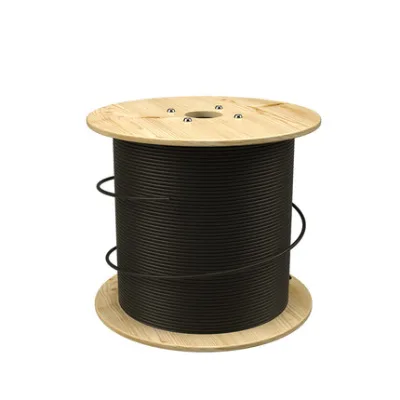
How is flat indoor drop cable packed for shipping?
Listed packing options include wooden drums and wooden reels, with one listing citing a reel size of 43 by 43 by 36 centimeters. Wooden drum packing protects the cable during long-distance transport and supports controlled payoff during installation. Confirm cable length per drum, total weight such as the listed 18.5kg/km, and export packing standards with your supplier.